PROJECTS
& ACTIVITIES
COLLECTION INVENTORY PROJECT 2004-2010
COLLECTION DATABASE PROJECT 2010-2013
The Leon Levy Foundation/CKS Collection Inventory Project of the National Museum 2004-2010
———————————————————
Now in its final phase, the Leon Levy Foundation/CKS National Museum Collection Inventory Project has brought a revitalized sense of order to the Museum’s collection and personal confidence to trained Museum staff, who now oversee this important ongoing project. It has greatly assisted the Museum’s international exhibition and publications programs, identification and repatriation of missing works of art, links with re-established provincial collections and the fostering of both established and newly formed conservation workshops in stone, metal and ceramics. It has won international acclaim.
Most importantly, the location and condition of thousands of works of art in storage have been digitally catalogued, with works arranged in a logical and systematic way. Ongoing agendas include digital photography of every work, scanning of extant French inventory cards and cross-referencing the past and present catalogue systems.
Greatly improved trilingual labeling now offers visitors clear and accurate identification of some 2,000 works on display and provides a great resource for researchers wishing to access the collection. It wasn’t always so. In the wake of the Khmer Rouge regime, the National Museum, repository of the extraordinary treasures of Cambodia’s past, had suffered from years of neglect, was run by a staff lacking formal training, and occupied a building ill-equipped for the second millennium.
The conditions of Museum storage were particularly worrisome. Locating a work of art in its basement was challenging. Documentation was incomplete and inaccessible.
A fofortuitous visitor and a collaboration with CKS
In early 2004, art historian and CKS Trustee Emma Bunker visited the National Museum with a group of friends, including the distinguished collector Douglas Latchford and American arts patron and philanthropist Shelby White. They met with director Khun Samen and his then deputy, Hab Touch at the Museum. Moved by the poor conditions of the Museum, Shelby White generously offered to fund a long-term project through the Leon Levy Foundation, in collaboration with the Center for Khmer Studies. They agreed on the all important goal of an inventory project - a bold undertaking to catalogue the Museum’s entire collection.
In the grant proposal, the current situation and the project’s ambitions were starkly set forth:
‘’When the Museum officially opened on 13 April 1920, there were over 1,000 objects on display. Today the museum has approximately 14,000 objects and the collection is growing at a rate of over 300 objects per year. The majority of the collection is stored in a basement storage area. The project will bring together, and draw on, all existing registration methods used by the Museum at different times in the past, including several French card catalogue systems, Khmer handwritten inventory lists and a pre-existing database. As part of the inventory and cataloguing project, all previous documents relevant to a particular object will be scanned and attached to that object’s record in a newly developed database’’.
The project began in August 2004. Darryl Collins was chosen as the project coordinator, to train the staff and set up the cataloguing procedure. During the course of the project, Shelby White and CKS President Dr. Lois de Menil made several visits to the National Museum in Phnom Penh. Shelby White, accompanied by Emma Bunker, returned in 2006. Dr. de Menil and Emma Bunker visited regularly. From the outset, the Center for Khmer Studies assured regular financial and administrative oversight of the project. As the growth and success of the project proceeded, the initial 3-year grant was extended to a period of 6 years that have seen to completion the documentation of the entire Museum collection.
Press acclaim and new international visibility
Once underway, this major project was widely acclaimed by the national and international press, drawing new attention to the National Museum and the importance of its collections. The Cambodia Daily noted aptly, in 2005: “In the National Museum’s basement, order emerges from the chaos. ’A full-page article, entitled, ‘National Museum Inventory Project: Phnom Penh’ appeared in the London-based art newspaper Asian Art in October 2005, with Deputy Director Hab Touch commenting that he believed the project represented a major step forward for the institution, which until then had an incomplete knowledge of what was contained in its collection, and of what was missing. The International Herald Tribune titled its story, ‘A Belated Rescue of Cambodia’s Past.’
Impact on international scholarship and mission of the national museum
International researchers began immediately to hail the project and to make use of the increased access to museum data for exhibitions and publications. The conservation workshops within the Museum now have orderly ease of access to the collection, as do curators when works of art are required for either national or international exhibitions. Objects can now be quickly identified and located, with digital photos and detailed documentation. ICOM and ICOM-EFEO pamphlets and booklets have aided identification of missing works of art and alerted the world to trafficking in Khmer artifacts.
The project staff 2004-2010
The inventory project has benefited from the guidance and support of three Museum directors, Mr. Khun Samen, Mr. Hab Touch and later, Mrs. Oun Phalline. Registrars, photographic personnel and cataloguers drawn from the museum staff have now been trained. Those attached to the project number eight. The initial staff trained for the first year numbered four, three of whom are still with the project. Results speak volumes for the dedication of museum staff, for their willingness to work on the collection in a methodical and committed manner - to record, photograph, calibrate and locate works under less than perfect conditions.
Discussion is underway to complement the cataloguing project with a project to provide computers, equipment and training to provincial museums, using National Museum staff as trainers, with the object of ensuring that these collections become part of a greater Cambodian museum network. It is the Museum’s deep hope that ongoing discussions will reach a successful outcome and a new collaboration. This important project would never have taken place without the vision and generosity of American philanthropist and CKS patron Shelby White and the Leon Levy Foundation.
The Leon Levy Foundation/CKS Collection Database Project of the National Museum 2010-2013
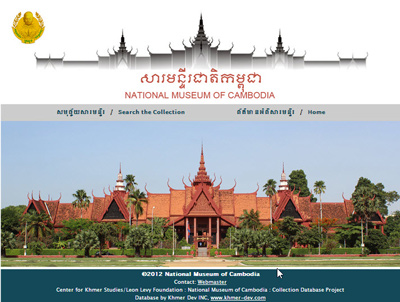
Members from the Ministry of Culture and Fine Arts and staff of the National Museum of Cambodia, together with the Center for Khmer Studies joined in celebrating the public launch of the ‘National Museum of Cambodia: On-line’ on 3 January 2014.
A three-year grant from the foundation has enabled all the primary text and image files produced over a six-year period to be incorporated into a database that is used to fully catalogue the museum collection in addition to providing access to search the present collection on-line in both Khmer and English.
This purpose-built database based on international museum software is the work of Khmer Dev INC, Phnom Penh working in tandem with the museum’s IT programmer - proudly a Cambodian enterprise. It is a necessarily complex system that incorporates demands for three language texts English, French, Khmer, digital colour images and scanned catalogue cards. It performs a host of secondary functions other than ‘search the collection’. The database can be used to off-print museum labels to specified formats, produce loan documentation, has entries for reportage, conservation records with varying formats for search lists as required. One special feature is the capability of this system to be exported to the Cambodian provinces and a version of the cataloguing system made available to staff outside the capital enabling them to catalogue their own collections. Khmer-English glossaries, terminology and geographic location indexes & etc. can be directly sourced from the National Museum system.
Collaboration with CKS
This project had its origins in August 2004 with the Collection Inventory Project that ran for 6 years concluding in 2010. Darryl Collins began as project coordinator, to train the staff and set up the cataloguing procedure then oversaw the building of the database. The second program, Collection Database Project, concluded after a further 3 years in December 2013.
For nine years, the Center for Khmer Studies assured financial and administrative oversight of the project. President Dr. Lois de Menil and Emma Bunker, board member have deep commitments to the projects and steered the course of both programs ensuring its place as “one of the longest and most important CKS programs” to date - both in enduring importance in training the staff of Cambodian museums, the rehabilitation of tangible culture and the lasting significance of documentation of this important part of the national estate.
International research and public outreach
With the view of making information of the national museum collections internationally available, the Council of Ministers, Ministry of Culture and Fine Arts, together with agreement from individual museum directors are all to be congratulated on their foresight in allowing access to both selected images and data from the National Museum through ‘Search the Collection’ link on the museum website at: www.cambodiamuseum.info
Available to the general public, students, overseas Cambodian communities, international museum personnel, visitors, scholars & researchers, the system operates on several levels, with the collections divided in original media categories that can be searched by inventory numbers (where known), media division, keyword title, geographic find location, or a combination of these categories in advanced search mode.
Mission of the National Museum
Cataloguing of the collection as at end of December 2013 within eleven categories stood at:
01-Stone 3,307; 02-Ceramics 4,316; 03-Metal 7,367; 04-Textiles 229; 05-Paintings 49; 06-Wood 494; 07-Manuscripts 481; 08-Plastic 30; 09-Glass 32; 10-Skin 21 & 11-Horn 112.
The Museum collection now stands at a total of 16,493 works of art. In 2004, at the commencement of the programs, an estimate of the Museum’s collection numbered around 14,000 objects.
An integral part of cataloguing works of art is documentation and identification - researching art styles, periods in addition to provenance, or history of ownership. Using the new Database Project resources, the Museum is now in a position to digitally present its internationally-famed collection.
Project Staff 2010-2013
The database project has recently benefited from the guidance and support of three Museum directors, Mr. Hab Touch, Mrs. Oun Phalline and most recently, Mr. Kong Vireak. Staff attached to the project number eight with two part-time staff added in the last months of the project to ensure the deadline was met. Tribute should be paid to ten museum staff, whose committed work resulted in the completion of this gargantuan task with now in excess of 16,490 works of art fully digitally documented.
Museum collections are never static and the National Museum will continue to grow through new archaeological finds, purchases, restitutions and gifts. The database requires regular updating and revision as Cambodian and international scholars and researchers learn more about Khmer culture. The staff are now well-equipped to meet this task.
Mr. Chhuon Sareth Registrar
Mr. Ros Sinath Registrar
Mr. Nguon Sophal Photographer
Mr. Tit Sokha Registrar and photographer
Ms. Khun Sathal Registrar
Mr. Kimsan Piseth Registrar
Mr. Chhay Sopheap IT manager
Mr. Pich Vannak Registrar
Ms. Vorn Kunthea Part-time registrar
Ms. Phal Sreymom Part-time registrar
Mr. Darryl Collins Project manager
Future vision
A proposed project as an extension of the Collection Database Project is the Collection Records Retrieval of “lost works of art” for a five-month program from early to late 2014. This program could be paired with proposed training and extension of the Collection Database Project (CDP) to Cambodian Provincial Museums.
Target collection areas include: Archives, documents, official dress, photographs; Arms, furniture, utensils; Ceramics; Metal; Precious objects, numismatics; Stone; Textiles; & Wood.
This project, Collection Records Retrieval (CRR), can effectively link staff with the present CDP project mentioned above; with Museum staff servicing both the in-house records of missing works of art and extending this expertise to select provincial collections. A publication (currently in press) with UNESCO for missing works at Battambang museums highlights the ministry’s desire to re-open Wat Po Veal (collection greatly depleted), together with recovery of works from the Battambang Provincial Museum.
Using existing catalogue cards and registers, old catalogue records for missing works of art and coupled with pre-digital photographic scanned images a ‘missing work of art record’ can be posted on the National Museum of Cambodia collection database together with the present 16,490+ ‘digitalized’ extant items.
Effectively this would recreate the museum collection as it once was (from pre-1920), covering periods of civil war, neglect, closure and theft. It may well prove to be extremely useful in possible restitution of items providing positive identification and complete the collection records from the period of the visionary founding curator, George Groslier.
This proposal has the backing and approval of the current museum director, Kong Vireak and H.E. Hab Touch, general director, General Department of Cultural Technique, Ministry of Culture and Fine Arts.
|