|
PROJECTS
& ACTIVITIES
CONSERVATION
—————————————————
As an institution dedicated to the preservation
and protection of Cambodia’s important art and architectural
heritage, conservation is one of the most important activities carried
out at the National Museum of Cambodia. Two conservation workshops
have been established at the Phnom Penh museum, one for Stone objectss
and the other for metal. The stone workshop was founded in 1996,
while the metal conservation laboratory was launched in 2005. The
staff members of these workshops have now been trained in contemporary
conservation techniques, and have carried out extensive repair and
preventative conservation work on many art objects in the museum’s
collection.
|
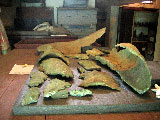
Stone
conservation workshop
.jpg)
|
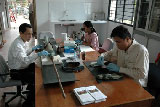
Metal conservation laboratory
|
Stone
Conservation workshop
The EFEO started renewing contacts with the National Museum of
Cambodia in 1996 (Phnom Penh) with the establishment of a workshop
for conservation and restoration of stone sculpture in cooperation
with the Ministry of Culture and Fine Arts of the Kingdom of Cambodia.
At its inception, the workshop strived to restore a selection
of masterpieces exhibited in Paris, Washington, Tokyo and Osaka
between 1997 and 1998.
Since then, numerous activities—almost 1,200 for the museum—have
been undertaken in accordance with conservation and restoration
ethics. These activities range from superficial cleaning to the
dismantlement / de-restoration and structural assembly of occasionally
complicated items. All these operations, documented and recorded,
aim at improving the conservation methods and the relevance of
the new display.
Researches carried out simultaneously with these activities have
enriched our knowledge of numerous of these artefacts. Many sculptures
and stone inscriptions have now been better identified and sometimes
supplemented. Field surveys are being carried out on the sites
of old or recent discoveries. The research is based on the closely
associated database of the National Museum, the Angkor Conservation
and the EFEO. It benefits from the network of researchers (archaeologists,
historians, epigraphists, architects etc.) brought together by
the EFEO and the nearby Royal University of Fine Arts. Sampling
of carved sandstone allows petrographers to better identify the
variety of stones used, according to the regions and periods of
ancient Cambodia. An exhaustive photographic documentation is
registered in a permanently updated database. The workshop is
currently reviewing and documenting the old museum's photographic
collection.
Training is of course paramount. The current team is made up of
six staff of the museum. They have all been able to develop specialties
in restoration practices, documentation, conservation of inscriptions,
and etc. Former members of the team still hold positions in the
field of heritage conservation. Many trainees, students from the
Royal University of Fine Arts and foreign students, also participate
in workshop activities.
Works often revolve around different thematic. The workshop is
for example widely recognised in the mastering of the rubbing
technique of stone inscriptions, or the statuary from a specific
site like Phnom Da.
The work often leads to the establishment of new permanent exhibitions:
the post Angkorian Buddha, pre-Angkorian and Angkorian inscriptions,
and the museum's history. Temporary exhibitions have also been
organised, such as those devoted to new acquisitions, images of
Ganesha and goddesses.
Periodically, the workshop team sees to the preparation and monitoring
of many of the museum artefacts selected for international exhibitions
of Khmer art.
The workshop regularly intervenes on collections located in the
provinces, notably at the Angkor Conservation and at the Battambang
and Takeo museums. Since 2004, the workshop has developed major
collaborative work with the Museum of Cham Sculpture of Danang
and the History Museum of Ho Chi Minh City. Workshops have been
established and many sculptures have been restored and newly displayed.
A new collaboration has started in 2010 with the Wat Phu site
museum, in Laos.
|
|
|
.jpg) |
Metal Conservation Lab - $15,000 (U.S. Smithsonian
Institution/Freer and Sackler Gallery of Asian Art)
Goal: Laboratory for conserving metal objects, training of metal
conservation
practitioners.
Partner and location: National Museum of Cambodia/Phnom Penh
(Additional funding: $125,950 from the Getty Conservation Institute
and $12,000 from the Global Heritage Fund.)
|
|
|
|
Bronze
Conservation Laboratory
In 2005 the Freer Gallery of Art and the Arthur M. Sackler Gallery
of the Smithsonian Institution undertook to establish a workshop
in the National Museum to train three Cambodian museum staff members
and one other intern in methods of bronze conservation. Under
the guidance Paul Jett, the head of the Galleries’ Conservation
Department, metals conservator Sean Charette began training the
team of Cambodians in techniques for the protection and restoration
of the National Museum of Cambodia’s approximately 6,800
metal objects. Initial funding came from the Getty Foundation,
Global Heritage Fund and Fulbright Senior Specialist Program.
In order to continue the training for a second year, further funding
was required, and FOKCI is supporting this project. At the conclusion
of this project, not only will many of these important Bronze
objects in the National Museum be conserved, but, as importantly,
several Cambodians will have become skilled in bronze conservation
techniques.
|
"Bronze Conservation at the National Museum
of Cambodia"
by Paul Jett, Head of Conservation and Scientific Research, Freer-Sackler
Gallery of Art
The National Museum of Cambodia is located in Phnom Penh and
features a world-renown collection of Khmer artifacts from the
9th – 15th C. AD. Among these collections are approximately
6,800 Bronze objects, with over 600 on permanent display. Recently,
Paul Jett of the Freer-Sackler Gallery of Art, headed up a project
to conserve these significant cultural artifacts.
The goals of the project include completing a thorough survey
of the bronze collection to determine its overall condition and
needs, and establishing a laboratory facility for bronze conservation.
The project will also include performing conservation treatments
on selected bronzes from the collection, training members of the
museum staff in the care and treatment of bronze, and finally,
improving storage for the collection.
To carry out the project, a consulting conservator, Sean Charette,
was hired to work on site at the National Museum for an eighteen
month period. In addition, staff members from the Freer conservation
lab have been traveling to Cambodia for stays of two to three
weeks in order to work with Charette on the various aspects of
the project. After Charette concludes his period of stay at the
museum in the fall of 2006, follow-up visits are planned in order
to provide further training and support for the project and to
assist museum officials in planning for the future of the bronze
conservation program. Materials shipped from the United States
were used to establish a basic conservation laboratory at the
National Museum. A core group, made up of four of the museum staff,
were then trained to complete condition surveys of the entire
bronze collection. This was quite a task due not only to the large
number of artifacts, but also to the objects’ condition.
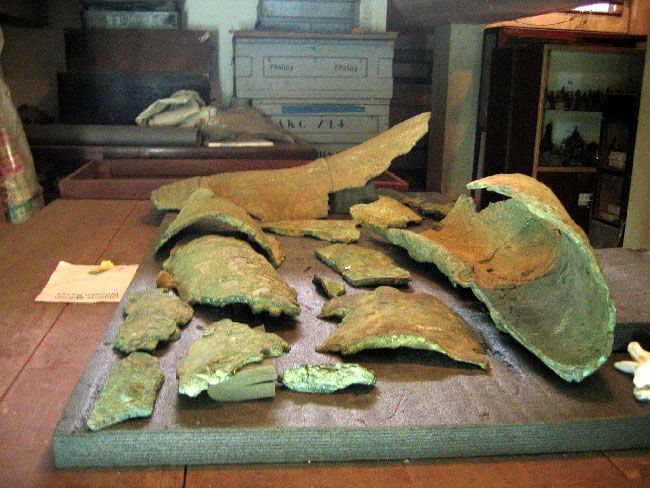
A number of the bronzes had been sealed in bags by the museum
staff over thirty years ago when the museum was closed before
the Khmer Rouge took control of Phnom Penh and many of these objects
have yet to be unsealed.
The improvement of the storage condition of the artifacts was
another important goal of this project. The environmental conditions
in Phnom Penh are not exactly ideal, since the area is subject
to seasonal rains. Although some parts of the museum do flood
during the rainy season, this was overcome by using storage systems
that keep everything well off the ground. The last step was to
provide additional training in basic conservation to a small group
of the museum staff. In addition to being taught to perform conservation
treatments, the staff is also learning about bronze casting techniques
and other topics that will further their understanding of the
objects. It is hoped that the project will ultimately not only
address the goals listed above, but will also create a self-sufficient
laboratory that eventually serves as a center for bronze conservation
in Cambodia.
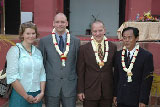
Dedication of the Metal Conservation Laboratory
Remarks by Ambassador Joseph A. Mussomeli
National Museum of Cambodia
March 23, 2006
Your Royal Highness Prince Sisowath Panara Sirivuth, Minister
of Culture; Khun Samen, Director of the National Museum of Cambodia;
Excellencies; Members of the Press; Ladies and Gentlemen,
It is a great honor for me to be here with you this afternoon
for the dedication of the newly renovated Metal Conservation Laboratory
here at the National Museum of Cambodia. One of Cambodia’s
most precious assets is its cultural heritage. Regrettably, historic
monuments suffer from years of neglect, looters target archaeological
sites and ancient temples, and priceless carvings and artifacts
held in the national collection are deteriorating due to the ravages
of time. I am reminded of the words of one of my favorite actresses—actually
I had a terrible crush on her when I was about 8 years old, and
later in life she entered Greek politics, Melina Mercouri. She
once explained that “the past must emerge from the museums
in order to become a source of inspiration and creativity, to
become the inspiration and the joy of the people.” And she
also warned that “our common memory is threatened, our soul
shrivels, our creativity stifles, and our present becomes rootless”
whenever our cultural heritage is stolen, neglected, or destroyed.
The U.S. is committed to the protection of Cambodia’s heritage,
and the opening of this laboratory represents just one aspect
of my country's assistance to Cambodia in this endeavor. The Metal
Conservation Laboratory is a custom built space for the conservation
treatment of metal objects and is stocked with the necessary tools,
equipment and supplies. More importantly, it is also the setting
for the training of Cambodian staff in modern conservation theory
and techniques. This is crucial because ultimately it is up to
the Cambodian people to preserve and protect their cultural heritage,
and this training will enable them to take charge of this important
matter.
I would like to thank several key individuals, without whom this
Metal Conservation Lab would not have been possible. First, I
wish to express my sincere appreciation to His Royal Highness
Sisowath Sirivuth, for his advocacy and support on behalf of the
Ministry of Culture. I would also like to thank National Museum
Director Khun Samen for his lifelong commitment to the preservation
of Cambodia's magnificent cultural heritage. It was Khun Samen
who first presented the idea of the Metal Conservation Lab to
the Freer and Sackler Gallery. Finally, I would like to recognize
Sean Charette for all his work on behalf of the U.S. government
to set up the lab and to train its staff.
Over the last few years, the U.S. government has provided nearly
three quarters of a million dollars to fund cultural preservation
projects in Cambodia, including restoration work at Phnom Bakheng
at Angkor, the collection and Publications of 30 oral folktales
in Khmer, emergency excavations at Wat Jas, the revival of the
classical Lakhaon Kaol dance, and a national education program
on the importance of cultural preservation. Additionally, in 2003
the U.S. and Cambodia signed a bilateral agreement that imposes
import restrictions on Khmer archaeological material entering
the United States. The agreement comes up for renewal in 2008,
and the U.S. Embassy is committed to working with the Ministry
of Culture to ensure this happens.
Prime Minister Hun Sen has been quoted as as saying: “We
are ... each citizen.” well aware that both tangible and
intangible cultural heritage constitutes a harmonious whole in
the national identity. These cultural assets testify to the evolution
of the civilization of a nation. Cultural heritage is usually
regarded as the soul of the nation. Therefore, the protection
of cultural heritage should not be confined solely to the government,
but is also the duty of each citizen.
The United States is proud to be a partner in the protection
and preservation of Cambodian cultural patrimony. And we join
in the Prime Minister’s call for each and every person to
play his and her part. An added incentive is the important role
that culture now plays in Cambodia's economy. More than one million
visitors will travel to Cambodia this year to marvel at the country’s
temples, archeological sites and historical artifacts. The National
Museum alone draws thousands of tourists a month. Tourism now
employs over 100,000 workers, making it Cambodia’s second
most important industry. In working to preserve Cambodia's past,
we are also ensuring Cambodia’s future.
|
Back to top
| | |
|




.jpg)
.jpg)
.jpg)
.jpg)
